


Expert guide · Technology
People counting technologies compared: beam, thermal, 3D stereo, time-of-flight, AI video and Wi-Fi (2026)
Every sensor technology used to count people, explained by how it detects a person — because that is what decides what fools it. With typical accuracy, mounting heights, power needs, privacy footprint and the entrance each one belongs on. Twenty years of installing and supporting all of them, including the ones we do not sell.
Published by SMS Storetraffic. We make a beam counter and a 3D stereo counter, so we have opinions. Where a claim is ours it is labelled; where another technology is the better fit, we say so.

A 3D stereo sensor: two lenses, one height map, one PoE cable — our 3D Scope II LC
The short answer: in 2026 there are four technologies worth buying for a door — horizontal infrared beams (cheap, wireless, single-file only), overhead thermal (works in the dark, no image, weaker on crowds), 3D stereo vision (the accuracy leader for busy and wide entrances, needs a cable) and time-of-flight depth sensors (stereo-like accuracy with no colour image at all). 2D video is outclassed, passive infrared is a beam with worse habits, and Wi-Fi/Bluetooth counting was ended by phone makers randomising device addresses.
Standard door, tight budgetWireless infrared beam. Consistent, good enough for trends and conversion, and the only technology that runs on batteries for most of a year.
Busy, wide or glass entrance3D stereo. Separates people walking abreast, filters children and carts by measured height, ignores U-turns and lingering. The technology to beat since about 2010.
Dark or outdoorThermal, or an outdoor-rated stereo unit. Thermal needs no light at all; stereo needs roughly 3 lux and a sealed housing outside.
Strictest privacy postureBeam, thermal or time-of-flight: no image can exist. Stereo counters reduce frames to depth on the device and transmit counts only, but they do contain cameras.
Not a counterWi-Fi/Bluetooth sniffing and mobile-location datasets estimate; they do not count your door. Useful for dwell and market context, regulated as personal data in several jurisdictions.
Side by side
Every people-counting technology, compared
Accuracy figures are the ranges vendors publish for their own products under good conditions; the two sensors we sell are marked. Mounting heights are typical published ranges. “Privacy” describes what the sensor can capture by design, which is what matters legally, not what a particular installation is configured to keep.
| Technology | Detects | Typical accuracy | Side by side | Child / cart filter | Direction | Mounting | Power | Light / weather | Privacy | Hardware cost |
|---|---|---|---|---|---|---|---|---|---|---|
| Horizontal infrared beam PEARL | Beam between two units broken | 95–98%, single-file adults | No — counts one | By mounting height | Yes, with two beams | Wall or frame, 54 in (adults) / 24 in (all); spans to ~15 ft, more when wired | AA batteries 6–9 months, or wired | Direct sun shortens range; indifferent to darkness | No image possible | $100–$500 |
| Overhead passive infrared (PIR) | Change in heat radiation under a narrow zone | Lower; consistent in mall interiors | No | No | Two zones needed | Ceiling over the lease line | Wired or battery | Fooled by rapid temperature swings at outside doors | No image possible | $100–$400 |
| Overhead thermal array | Warm shape tracked against a cooler floor | 95–99% claimed | Yes, until shapes merge | Weak — heat, not height | Yes | Ceiling, ~2.5–4.5 m | Wired, or battery + cellular (~2 yrs) | Works in total darkness and outdoors; heaters and sunlit floors can confuse it | No recognisable image | $300–$800 |
| 2D mono video | Moving pixels against a learned background | 80–95%; falls in crowds and hard shadows | Partly | Poor — no height | Yes | Ceiling | PoE | Sensitive to shadows, glare and lighting changes | Real images; CCTV rules apply | $200–$700 |
| 3D stereo vision 3D Scope II | Two lenses compute a height map; heads tracked as objects | 95–99%; some vendors guarantee a floor | Yes | Yes, by height and shape | Yes, multiple lines | Ceiling, ~2.2–6 m; high-mount models to 20–25 m | PoE, under 8 W | Needs ~3 lux; HDR handles glare; outdoor models sealed | Depth on device; video off by default on good systems | $300–$1,200 (most $650–$1,200); outdoor to ~$2,000 |
| Time-of-flight / LiDAR | Timed infrared pulses give a depth map | 95–98% claimed | Yes | Yes, by height | Yes | Ceiling, typically 2.5–5 m; range-limited | PoE | Works in darkness; strong sunlight degrades it | Geometry only; no image possible | $500–$1,200 |
| Wi-Fi / Bluetooth sniffing | Phones broadcasting nearby | Estimates; degraded since 2015 by address randomisation | Counts devices | No | No | Anywhere in range | Wired | n/a | Device identifiers; personal data in the EU and Quebec | $100–$500 + platform |
| Pressure mats, turnstiles, door-swing counters | Weight on a mat; a barrier turn; a door opening | Turnstiles ~100% per turn; mats and door counters low | No | No | Turnstiles yes | Floor / gate / door | Varies | n/a | No image | Wide range |
Sources are listed at the end. Cost bands come from the published prices in our nine-system price comparison plus the retail prices of consumer-grade beam counters sold online; no competitor is quoted on this page.
Before the hardware
Two ideas that matter more than the technology
Consistency beats accuracy
Accuracy is how many of the people who crossed were counted. Consistency is whether the same share is counted every day. A system that reports 85% every day can be trusted: Saturdays are still bigger than Tuesdays, this year still compares to last, and every ratio built on it is stable. A system that reports 100% one day and 50% the next is worthless whatever its average. This is why a beam, which misses the same kind of crossing every time, remains a legitimate instrument — and why an unreliable network or a dying battery does more harm than a percentage point.
The more that can go wrong, the less you can trust
Every technology has a list of things that break it. The useful question is not “which list is shortest” but “which list does my door trigger”. Beams die on frameless glass and displays in the doorway. Thermal dies on heat sources and standing still. Stereo dies on darkness and ceilings above its range. Wi-Fi died on a software update from Apple. Match the failure list to the entrance and most accuracy problems never happen.
Technology 1
Horizontal infrared beam counters
The original people counter, in use since the 1980s and still the most-installed type. An infrared transmitter on one side of the doorway shines at a receiver on the other; when a body interrupts the beam, the receiver registers a count. That is the whole mechanism, and its simplicity is both its strength and its limit.
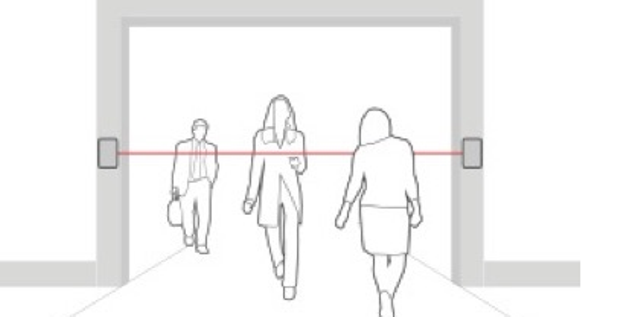
A beam counter registers a count each time the line between the two units is broken. Two people crossing side by side break it once.
Where beams work best
Small-to-medium entrances with low-to-medium traffic, where people mostly arrive single file: doors leading to the outside that open outward or are propped open, standard aluminium frames to mount on, openings from about 6 ft (2 m) up to 15 ft (some wired units reach 25 ft, a few 100 ft). In a mall with a row of double doors and low traffic, one pair can span several doors if you accept the lost accuracy.
The 54-inch rule
Mount at 54 in (137 cm), chest height, to count adults only: strollers, carts, dogs and children pass underneath. The height is not arbitrary. A beam is fast enough to count an arm and then the body behind it; 54 in is above where most people swing their arms or reach to push a door, so it avoids the double count as well as the child count. Mount at 24 in to count everyone — libraries and museums usually want children counted.
What breaks a beam
- Two abreast is one count. On a busy Saturday the undercount grows — consistently, so trends survive, but the absolute number is low.
- Frameless glass and inward-swinging doors. Nothing to mount on, and the door swings through the beam. Mount beyond the swing or use an overhead sensor.
- Automatic doors with infrared safety curtains. The door’s own strong infrared pulses interfere with a low-power counting beam; mount at the wall edge or further into the store (our notes).
- Displays and greeters in the doorway. A rack, a sign or a person standing on the beam blocks every count behind them.
- Direct sunlight on the receiver shortens range — our PEARL covers 15 ft normally and 7 ft in bright sun.
- Tampering. Units at hand height are easy to bump, block or, occasionally, sabotage by a manager under pressure about conversion. Good systems alert you when the beam is obstructed.
Variants
Reflector beams use one active unit and a mirror; cheaper, but the reflector is bulky, easily knocked and prone to sunlight errors. Transmitter/receiver (Rx/Tx) beams are smaller and more reliable; every beam we have sold uses them. Directional beams put two beams a few centimetres apart on each side: A then B is an entry, B then A an exit. Wireless beams pulse the beam to save power and run on batteries for most of a year; they are the entry point for most first-time buyers, at the price of a battery routine and a radio link that is very stable in 2026 but never quite as certain as a cable. For a chain of a hundred locations, that maintenance load is the real argument for spending more.
Our beam: the PEARL — an Rx/Tx pair on AA batteries over 2.4 GHz Wi-Fi, peel-and-stick, in/out, upwards of 98% on adult traffic, $499.95 with software from $0. It is the right sensor for a standard door and the wrong one for a wide, busy or glass entrance, which is why we also make the next thing.
Technology 2
Overhead passive infrared (PIR) counters
The same sensor that switches on a security light. Mounted over the lease line, its detection zone is narrowed to a virtual line a few inches deep; a warm body moving through it triggers a count after a reset time of half a second to two seconds. It is inexpensive and has no image, and in a climate-controlled mall corridor with free-flowing traffic it behaves like a ceiling-mounted beam.
Its failure list is the beam’s plus three: it is upset by rapid temperature change, so an entrance to the outdoors on a cold day generates phantom counts; it cannot filter children or carts because it sees heat, not height; and a person who dawdles or stands in the zone can be counted repeatedly as the sensor resets. Battery-powered PIR units add ceiling-height battery changes that knock the unit out of alignment. We stopped recommending PIR for most retail doors a decade ago; it survives in some low-cost occupancy sensors.
Technology 3
Overhead thermal counters
A low-resolution thermal camera looks straight down and sees people as warm blobs moving across a cooler floor. Firmware tracks each blob and counts it when it crosses the line. Pioneered in the UK in the 2000s, thermal is today the technology behind the battery-and-cellular counters on the market, several of which pair a thermal array with machine learning.
Strengths
- Counts in total darkness and outdoors; lighting and shadows are irrelevant.
- Counts several people at once and filters U-turns; multiple count lines.
- No recognisable image can be formed from a thermal array of this resolution — a strong privacy position.
- Low power: the only overhead technology that runs on a battery for years, with a cellular modem, so it needs neither Wi-Fi nor a cable.
- Units can be linked to cover a wider opening as one.
Weaknesses
- Standing still. Older units continuously relearn the background temperature; a person motionless for a few seconds could fade into it and be re-acquired on the wrong side of the line, producing a false count. Modern firmware has reduced this markedly.
- Heat sources — a radiator, a sunlit patch of floor, a hot drink — can look like people; tight crowds merge into one blob.
- No height, so children and carts are hard to exclude, and mounting range is narrower (roughly 2.5–4.5 m for classic units).
- Accuracy claims have been debated: Wikipedia’s generational summary puts early thermal at 80–85%, while today’s vendors claim 95–99%; some publish no figure at all. Ask for the floor.
Verdict: a correctly calibrated thermal counter is a system you can trust, and for a dark entrance, an outdoor gate or a site with no network and no cable it can be the best choice. For a bright, busy retail door with families and carts, stereo does more.
Technology 4
2D (mono) video counters and re-used CCTV
A single camera looks down; software separates moving foreground from a learned background and counts the blobs that cross a line. It was the third generation of counting (roughly 2012 onward) and it is now largely superseded, for one reason: a single lens has no idea how tall anything is. A shadow moving across the floor, a shopping cart, a child and an adult are all just moving pixels. Accuracy is fine in a quiet, evenly lit corridor and collapses in crowds, glare and hard shadows.
The same applies, with extra problems, to re-using security cameras. CCTV is mounted at an angle to see faces, which is the wrong geometry for separating people who overlap; it records identifiable video, which brings the full CCTV rulebook on signage, retention and access; and the analytics integration usually costs more than a dedicated sensor. Modern AI helps 2D video considerably (see below), but where a depth sensor is affordable, it wins.
Technology 5
3D stereo vision counters
Two lenses a few centimetres apart see the scene from slightly different angles; from the difference between the two images the sensor computes the height of every point below it, producing a depth map in which people are head-shaped objects at 1.5–1.9 m and carts are flat objects at 1 m. Each object is tracked across the field of view and counted once, in the direction it crossed the line. “3D” and “stereo” mean the same thing in this industry; the term was a marketing choice. Since about 2010 stereo has been the technology to beat for retail, and nearly every enterprise vendor, ourselves included, builds on it.
What depth makes possible
- People walking abreast are separate heads, so groups are counted correctly.
- Height filtering excludes children, carts and strollers by measurement rather than by mounting height; shape recognition can count carts and wheelchairs separately.
- U-turn filtering and “count once per crossing” logic ignore greeters, lingerers and the customer who steps in to check the weather.
- Multiple count lines per sensor, and several sensors stitched to cover a wide lease line as one.
- Staff exclusion with wearable ultra-wideband tags, which the sensor ignores without identifying anyone.
- Immune to shadows, which have no height, and with HDR imaging to glare and backlighting.
- Auditable: the sensor can record a short clip with count lines overlaid so you can verify it yourself.
What breaks stereo
- Darkness. Below roughly 3 lux the lenses cannot match features; we recommend at least 6 lux. Thermal wins here.
- Mounting height. Standard units cover ceilings of about 2.2–6 m; our 3D Scope II LC reaches 6 m (coverage chart). Atriums and concourses need high-mount models rated to 20–25 m.
- Reflective floors and glass in the field of view, hanging signs, plants and pendant lights.
- Placement over the door swing, stairs, escalators or a revolving-door mechanism; mount on the flat floor 1–2 ft inside.
- The cable. Every stereo sensor is powered over Ethernet. The run to the door is a real cost that is almost never in the quoted install time.
Ours: the 3D Scope II LC — stereo with on-device AI and HDR, 99% rated with a 95% floor guaranteed in writing for two years, one PoE cable under 8 W, coverage up to 8 × 8 m per sensor (8 × 22.8 m with two), in/out, adults and children, carts, groups, wheelchairs, U-turns, staff exclusion, video audit on request; $1,149.95, outdoor model $1,650. Where we lose: ceilings above 6 m, and anyone who needs age and gender, which we deliberately do not estimate.
Technology 6
Time-of-flight (ToF) and LiDAR depth counters
A time-of-flight sensor emits pulses of infrared light and times their return from every point below; the round-trip time gives distance, and distance from the ceiling gives height. The result is a depth map very like a stereo sensor’s — heads, carts and children distinguished by height, groups separated, direction known — but produced without any colour image at all. Popularised by the Microsoft Kinect, ToF was “new and promising” when we last wrote about it in 2016. It has since matured into a real alternative to stereo from several specialist vendors; LiDAR units apply the same principle with scanning lasers over larger areas.
Strengths
- Privacy by physics. There is no image to store, blur or leak; the sensor captures geometry. This is the cleanest answer to a procurement rule that says “no cameras”.
- Works in darkness, since it brings its own light.
- Stereo-class group separation and height filtering.
Weaknesses
- Sunlight swamps the infrared return; ToF is an indoor technology and struggles at sun-flooded entrances.
- Range and resolution fall with height, so coverage per unit is smaller than stereo and wide entrances need more sensors.
- Crowded, slow-moving entrances are its hardest case, as vendors acknowledge.
What changed since 2016
AI and edge processing: what “AI people counter” actually means
“AI” on a 2026 datasheet means the sensor runs a neural network on the device to classify what it sees, rather than applying hand-written rules. On a stereo or ToF sensor the network works on depth data: it learns what a head, a cart, a wheelchair, a stroller and a child look like from above, so the sensor can count carts separately, count a wheelchair user as a person, tell a tall child from a short adult better than a fixed height threshold can, and separate a tight group. On thermal sensors, machine learning has closed much of the accuracy gap to cameras. On 2D video, AI object detection rescued a technology that background subtraction had left behind.
Three things it does not mean. It does not mean video is being sent to the cloud — the whole point of edge processing is that only counts leave the device. It does not mean face recognition; a counter trained on head shapes from above never sees a face. And it does not mean accuracy is solved: an AI sensor mounted over a door swing, in the dark, or above its rated height still counts badly. The useful questions are the same as ever — what does the sensor capture, what leaves it, and what is the guaranteed floor.
Where AI adds capabilities you should think twice about: age and gender estimation requires real images of faces, is biometric processing under most privacy regimes, and is a different product with a different legal footing. Some vendors publish accuracy figures for it; we do not offer it by choice.
Technology 7
Wi-Fi and Bluetooth counting: why it stopped working
Between about 2012 and 2015 a sensor that listened for the Wi-Fi probe requests every smartphone broadcasts, and counted the unique hardware addresses, looked like a way to count people, measure dwell time and recognise repeat visitors at once. Its problems were always there — it counts devices, not people (none for a child, two for a rep with two phones), its positioning is poor to a few metres so it counts the pavement as the store, it needs Wi-Fi switched on, and it collects a device identifier that regulators in the EU and Quebec treat as personal data. Then the phone makers ended it.
Apple (from 2014) and Android 6 (2015) began randomising the address in probe requests; iOS 14 (2020) introduced a private Wi-Fi address per network, and iOS 18 (2024) added an option that rotates the private address every two weeks and turns it on by default for open networks (Apple). Unique-device counting became unique-random-string counting. Vendors that survived now sell Wi-Fi analytics as statistically corrected estimates or as opt-in guest Wi-Fi with consent. That can be useful for dwell time and zone flow in a mall. It is not a door count, and no serious vendor sells it as one any more.
The radio technology that is useful at a door in 2026 is ultra-wideband, in the other direction: staff carry a UWB tag and a receiver on the sensor tells the counter to ignore them (how our staff exclusion works). Consent is built in, because the only devices tracked are the ones you handed out, and the tags identify no individual.
Also seen
Pressure mats, turnstiles, door counters, radar and location data
Turnstiles and gates
Effectively 100% accurate per turn, because they enforce single file. Right for stadiums, transit and paid entry; wrong for a shop, where a barrier is a customer deterrent.
Pressure mats and smart flooring
Count footsteps or weight on a threshold mat. Cannot separate people, wear out, and are confused by carts. Niche.
Door-swing and magnetic counters
Count door openings, not people. A family of four is one count, a propped-open door is none. Acceptable only as a rough activity indicator.
mmWave radar
An emerging privacy-friendly option for presence and occupancy in rooms; works in darkness and through some materials, but struggles to separate people close together. Watch this space for corridors; not yet a retail door counter.
Mobile-location datasets
Location-data panels estimate visits to a category or a trade area from aggregated phone location data. Invaluable for market context — and not a measurement of your door. A 3% estimate error on a market is fine; on your conversion rate it is not.
Tally counters with a display
A beam or PIR with a number on the front and no software. More accurate than a person, but you are the software: reading, resetting, typing into a spreadsheet. Most owners stop within months.
A recurring question
Do you need directional (IN / OUT) counting?
Every overhead sensor gives direction for free, so the question only really arises for beams, where a second beam adds cost. Our answer has not changed in twenty years: for traffic analysis, no; for occupancy, yes, and then only with the best sensor you can afford.
Over any period, the people who came in and the people who went out are the same people. Staffing a half-hour on IN counts, or on total beam counts divided by two, produces nearly the same rota; staffing on “people currently in store” is less reliable, because it depends on when within the half-hour they left (the worked table). Conversion rate uses IN counts and is indifferent to OUT.
Occupancy is the exception and the trap. It is cumulative IN minus cumulative OUT, so every counting error persists. A 95%-accurate sensor at a door seeing 100 people an hour makes about five errors an hour; if they lean one way, and they do, the system believes there are 25 phantom people in the store by closing and 60 by Sunday night. That is arithmetic, not a fault. Live occupancy is a legitimate use — for capacity limits, gyms, study halls, event floors — but it needs a high-accuracy sensor on every entrance, a daily reset, and a manual correction button, which is how our Real-Time plan is built.
The “group counting” feature
Some sensors offer to count people who enter within a set distance of each other as one “shopping unit”, which raises the reported conversion rate. The distance rule cannot know whether two people are a couple, colleagues or strangers who arrived together, so it is arbitrary at best and flattering by design. We have offered it and we advise against it: count people, know that some of them shop in groups, and measure your improvement against a consistent baseline.
Decision
Which technology for which entrance
| Entrance | Choose | Avoid | Why |
|---|---|---|---|
| Standard single or double door, outward-opening or none, mostly single file | Wireless infrared beam | Paying for stereo | Consistent and cheap; the side-by-side undercount is small and stable at this traffic level |
| Busy door with groups, families, carts and strollers | 3D stereo, or ToF indoors | Beam, PIR | Only depth separates people abreast and filters by height |
| Wide lease line or open shopfront, 4–8 m | Stitched 3D stereo | Beam (blocked), single thermal (too narrow) | Multiple sensors work as one; coverage grows with height |
| Frameless glass, automatic sliding, or inward-opening doors | Any overhead sensor | Beam | No mounting point, door swing breaks the beam, safety curtains interfere |
| Dark entrance, cinema, nightclub, storage | Thermal, or ToF | Stereo, 2D video | Cameras need light; thermal and ToF do not |
| Outdoor gate, market, park entrance | Outdoor-rated stereo, or thermal | ToF (sunlight), indoor units | Sealed, heated housings; thermal indifferent to light |
| No network, no cable, no IT | Battery beam on Wi-Fi, or battery thermal on cellular | Anything PoE | The only two wire-free categories |
| Ceiling above 6 m | High-mount stereo from a specialist vendor | Standard stereo, thermal, ToF | Range; our own 3D Scope stops at 6 m |
| “No cameras” procurement rule | ToF, thermal or beam | Stereo and video, however configured | These three cannot form an image; the rule is satisfied by physics rather than by settings |
| Staff constantly crossing the line | Stereo with UWB staff exclusion | Beam (no way to exclude) | Tags let the sensor ignore employees without identifying them |
Common questions
People-counting technology: questions people ask
What is the most accurate people counting technology?
3D stereo vision, followed closely by time-of-flight depth sensing, for ordinary indoor entrances: both measure height, so they separate people walking abreast, exclude children and carts by measurement, and ignore shadows. Vendors publish 95–99%, and a few guarantee a floor (our 3D Scope II LC is guaranteed at 95% for two years). Thermal is the most accurate choice in darkness. Beams are less accurate on busy doors but very consistent, which is what matters for trends.
Thermal vs camera people counters: which is better?
Thermal wins in the dark, outdoors, on privacy (no image can exist) and on installation where there is no network or cable, since thermal units can run on batteries with cellular. 3D stereo cameras win on busy entrances with groups and carts, because they measure height and thermal does not, and on wide entrances where coverage per sensor matters. For a bright, busy retail door choose stereo; for a dark or wire-free site choose thermal.
How does an infrared beam people counter work?
A transmitter on one side of the doorway shines an invisible infrared beam at a receiver on the other. Each time a body interrupts the beam, the receiver registers one count; two beams a few centimetres apart give direction (A then B is an entry). Mounted at 54 inches it counts adults only, since children, carts and strollers pass underneath; at 24 inches it counts everyone. Two people crossing side by side break the beam once and count as one.
What is the difference between 3D and stereo people counters?
None. In this industry “stereo” refers to two lenses working together to compute depth, and “3D” describes the same result; which word a vendor uses is a marketing choice. Time-of-flight sensors also produce 3D depth maps without a second lens, so “3D” on a datasheet can mean stereo or ToF — ask which.
Can a Wi-Fi people counter still count people in 2026?
Not reliably. Wi-Fi counting relied on each phone broadcasting a fixed hardware address. iOS and Android began randomising probe-request addresses in 2014–2015, iOS 14 added a private address per network in 2020, and iOS 18 rotates it every two weeks on open networks. What remains is statistical estimation of devices, useful for dwell time and zone flow in large venues, and regulated as personal data in the EU and Quebec. It is not a door count.
Do people counting cameras store video?
Purpose-built 3D counters process images on the device into a depth map and transmit counts only; in normal operation no video or image leaves the sensor and no face is ever analysed. Most can record a short clip on request to verify installation or audit accuracy, and that feature should stay off otherwise. Beam, thermal and time-of-flight counters cannot form a recognisable image at all.
How high should a people counter be mounted?
Horizontal beams: 54 inches (137 cm) to count adults only, 24 inches (61 cm) to count children too. Overhead 3D stereo and time-of-flight sensors: typically 2.2–6 m (7–20 ft) ceiling height, with coverage growing with height; ours reaches 6 m and covers up to 8 × 8 m. Overhead thermal: about 2.5–4.5 m. Ceilings above 6 m need high-mount stereo units rated to 20–25 m.
Can a people counter tell adults from children?
Beams do it by mounting height: at 54 inches anyone shorter passes under the beam. Overhead 3D stereo and time-of-flight sensors do it by measuring height and, with on-device AI, by shape, so they can report adults and children separately and also count carts and wheelchairs. Thermal and passive-infrared sensors see heat rather than height and cannot filter children reliably.
Do I need a cable to install a people counter?
Only for overhead camera and depth sensors. Every 3D stereo and time-of-flight counter is powered over Ethernet and needs one Cat5e/Cat6 run to the door, which costs $150–$400 per drop and is rarely included in quoted install times. Battery beam counters over Wi-Fi and battery thermal counters over cellular need no cable at all.
What is an AI people counter?
A counter that runs a neural network on the device to classify what it sees from above — heads, carts, strollers, wheelchairs — instead of applying fixed rules. It improves group separation, cart counting and child filtering, and lets thermal sensors approach camera accuracy. It does not mean video is sent to the cloud, and it does not mean face recognition: a counter trained on depth data from above never sees a face. Age and gender estimation is a separate, face-based product with different legal implications.
Which people counting technology is best for privacy?
Beam, thermal and time-of-flight, because none of them can form a recognisable image: a beam sees an interruption, a thermal array a warm blob, a ToF sensor distances. They satisfy a “no cameras” rule by physics. 3D stereo counters contain cameras but reduce frames to depth on the device and transmit only counts, which regulators treat as low risk when video recording is off. Wi-Fi sniffing and face-based demographics collect identifiers and are regulated as personal or biometric data.
Is directional counting worth paying for?
For traffic analysis, staffing and conversion rate, no: IN and OUT are nearly symmetrical over any period, and IN counts (or total counts divided by two) give the same decisions. For live occupancy, yes, and only with an accurate sensor on every entrance plus a daily reset, because occupancy is IN minus OUT and every counting error accumulates through the day. Overhead sensors give direction for free; the question only costs money on beams.
Since 1972
One beam, one 3D camera

PEARL — wireless infrared beam Ours
Rx/Tx pair on AA batteries over 2.4 GHz Wi-Fi. Peel-and-stick, in/out, 54 in or 24 in mounting, doors to 15 ft. Upwards of 98% on adult traffic. For standard doors; not for wide, glass or automatic entrances.
USD $499.95 · software from $0
3D Scope II LC — stereo with edge AI Ours
Groups, height and shape filtering, carts, wheelchairs, U-turns, staff exclusion, multiple lines, video audit on request. 99% rated, 95% floor guaranteed for two years. PoE, up to 6 m mounting, 8 × 8 m coverage.
USD $1,149.95 · outdoor model $1,650
Check our work
Sources
Our own specifications come from our product pages and help centre, linked in place. Industry accuracy ranges are the figures vendors publish for their own products, summarised without naming them; no competitor is quoted or linked on this page. Named comparisons live on the comparison page.
Specifications and mounting heights
- SMS Storetraffic — 3D Scope II LC installation; coverage chart; PEARL and automatic doors; UWB staff filtering
- Wikipedia — People counter (history and generational accuracy figures)
Wi-Fi randomisation
- Apple — Use private Wi-Fi addresses (iOS 14 per-network address; iOS 18 rotation every two weeks)
- MAC address de-randomization for WiFi device counting (Computer Networks, 2022)
Prices
- SMS Storetraffic — nine systems compared (all published vendor prices, verified quarterly)
How this guide was made
This page replaces the three-part “How customer counter technology works” series we published in 2016, keeping what has stayed true — the 54-inch rule, the beam’s failure list, the thermal standing-still problem, the occupancy drift arithmetic, the scepticism about group counting and Wi-Fi — and updating what changed: time-of-flight matured, edge AI arrived, Wi-Fi counting ended, and prices fell. SMS Storetraffic sells two of the technologies described; we say so where they appear and name other vendors where they fit better. Corrections via our contact page.